

Most of us don’t spend much time thinking about what our bank is doing to the planet. But a new analysis from responsible investment group ShareAction shows why perhaps we should.
Europe’s biggest banks – including several major UK names – are not just failing to act on climate change, they’re in some cases moving backwards, even as extreme weather pushes up food prices, damages homes and puts pressure on household finances across the continent.
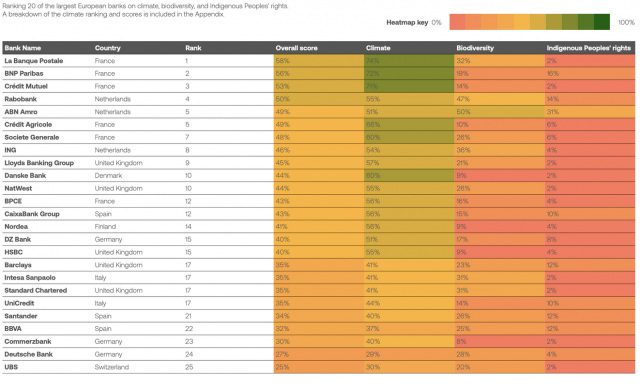
ShareAction assessed the 25 biggest European banks on their climate strategies, their treatment of nature and biodiversity, and their respect for Indigenous Peoples’ rights. The results are sobering.
Only four banks scored above 50 per cent: BNP Paribas, Crédit Mutuel, La Banque Postale and Rabobank. The average score was just 41 per cent, with UBS (25 per cent) and Deutsche Bank (27 per cent) propping up the bottom.
For UK consumers, several of the most disappointing findings sit close to home. HSBC, NatWest and Santander – three of the country’s biggest high-street names – have all weakened commitments to shift finance away from high-polluting clients.
That means they are now less ambitious than they were just a year or two ago. For banks that love to advertise their sustainability credentials, this slide is significant.
Barclays, meanwhile, scored just 35 per cent overall, placing it firmly in the lower half of the table. Despite years of public pressure over its fossil fuel financing, it still hasn’t put in place the kind of robust fossil-fuel restrictions that climate scientists say are essential.
Fossil fuel finance: still far off what the science demands
One of the clearest messages from the report is that fossil-fuel policies remain nowhere near aligned with climate science. The International Energy Agency (IEA) has been clear: no new oil and gas fields should be developed if we are to limit catastrophic global heating. But only four of the 25 banks assessed fully exclude financing for companies pursuing new oil and gas projects.
This is not a niche technical issue – it is the bare minimum required to keep climate goals alive. Even more concerning is that expansion of oil and gas infrastructure is still being funded with few meaningful checks.
Only four banks rule out finance for liquefied natural gas (LNG) terminals, despite IEA warnings of future oversupply risks. Fewer than half restrict financing for pipelines and other fossil fuel infrastructure. For UK customers hoping that their banks are helping steer us towards a cleaner, cheaper energy system, this will feel like a let-down.
Sustainable finance targets: ambition going backwards
ShareAction also found that five banks that have set new sustainable finance targets since May 2024 have actually reduced their level of ambition. In other words, they could meet these targets while providing less sustainable finance each year. It is a long way from the leadership that the climate crisis demands.
Why this matters for your money
ShareAction’s Head of Financial Sector Research, Xavier Lerin, said: “Banks have a crucial role to play in steering the economy through the challenges being thrown up by the climate crisis. Yet instead of leadership, most banks are slowing down their progress on climate and a concerning minority are even backsliding.”
For consumers, this isn’t just about ethics, it’s about financial risk. The longer banks cling to fossil fuel expansion, the greater the danger of stranded assets, instability and losses. Regulators are being urged to step in by requiring credible transition plans and updating capital rules to reflect the high risks attached to fossil-fuel investments.
What you can do
Good With Money readers have power. If you bank with HSBC, NatWest, Santander or Barclays, this is the moment to ask where your money spends the night.. and whether it’s funding the future you want. Switching to a bank with stronger climate policies, or using your voice as a customer to demand better, can send a signal that backsliding won’t go unnoticed.
The climate crisis is accelerating. Europe’s biggest banks should be too. For now, far too many are hitting the brakes just when they should be stepping up.