

Your workplace pension could become one of your biggest investments. But most of us know far less about where that money goes than we do about our bank account, mortgage or energy supplier.
Pension funds can invest in companies linked to fossil fuels, weapons and deforestation. They can also support renewable energy, cleaner transport, social housing and businesses tackling environmental and social problems.
You usually can’t choose the pension provider selected by your employer. You may, however, be able to switch funds within the scheme. This makes the default particularly important, as most employees simply stay in it.
We assessed the leading UK workplace pensions on their default funds, ethical exclusions, climate plans, positive investment, charges and transparency. These are the six that performed best overall.
How we use the Good Money Test
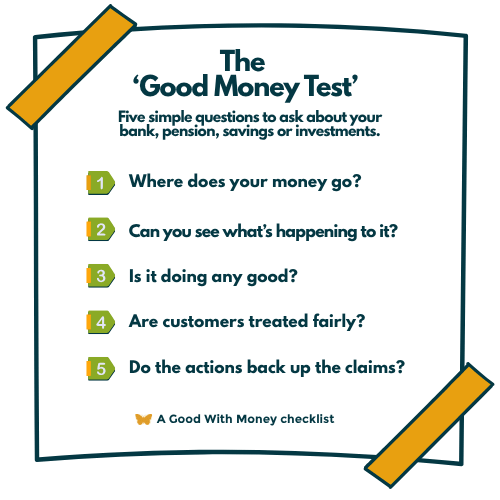
Our Good Money Test asks where your money goes, how transparent the provider is, whether it supports positive change, how it treats customers and whether its actions match its claims.
For workplace pensions, we also look at charges and whether the ethical approach comes as standard or requires members to switch funds.
The verdicts below are our editorial assessments, separate from Good Egg accreditation. This is a shortlist, rather than a ranking of investment returns.
Ethical workplace pensions at a glance
| Provider | What stands out | Good Money Test |
| Nest | Broad access, clear charges and a detailed ethical option | Strong pass |
| Smart Pension | Sustainability built into its main default | Strong pass |
| Pangea Impact Investments | A dedicated focus on positive impact | Pass |
| Aviva | A choice of ethical and sustainable funds | Pass |
| Cushon | An engaging app and investment in environmental and social projects | Pass, with reservations |
| People’s Pension | No shareholders and a tightly screened Ethical Fund | Pass, with reservations |
Nest
Good Money Test verdict: Strong pass
Nest is a useful all-round option, with clear charges and plenty of information about where members’ money goes. Set up by the government to support auto-enrolment, it must accept any UK employer wanting to use it for those duties.
Most members join its Retirement Date Funds, which adjust the investment mix as retirement approaches. These apply responsible investment policies, including restrictions on tobacco and controversial weapons, but aren’t fossil-fuel-free.
For stricter screening, members can choose the Nest Ethical Fund. It avoids companies owning oil, gas or coal reserves and applies restrictions covering weapons, tobacco, alcohol, gambling, pornography, animal fur and cosmetics testing on animals. It also seeks investments supporting areas such as renewable energy.
Nest charges employers nothing. Members pay 1.8 per cent on new contributions and 0.3 per cent a year on their pension pot.
Why it makes the list: Clear ethical policies, accessible information and an option for employers of almost any size. Members need to choose the Ethical Fund for its stricter exclusions.
Good for: Employers wanting a straightforward scheme with a well-explained ethical option.
Smart Pension
Good Money Test verdict: Strong pass
Smart Pension builds sustainability into its main default growth fund, helping it reach members who never make an active investment choice.
The Smart Sustainable Growth Fund invests across different assets and aims to benefit from companies helping solve environmental and social challenges. Smart targets net zero by 2040 for the listed assets in this fund.
Members wanting a different approach can choose from funds including the Smart Ethical and Climate Fund, which screens out companies that breach its ethical criteria. There are also impact equity, impact bond and Sharia options.
Charges depend on the scheme and funds. Members may pay a monthly fee alongside investment charges, while some employers also pay a monthly charge. Ask for a full quote when comparing providers.
Why it makes the list: Sustainability is built into the main default, supported by specialist fund choices and published climate and stewardship policies.
Good for: Employers who want sustainability to reach staff without relying on them to switch funds.
Pangea Impact Investments
Good Money Test verdict: Pass
Pangea focuses on investments seeking solutions to climate change and social inequality. Its workplace approach builds sustainability into the default, so employees don’t need to research and select a separate ethical fund.
It assesses investment managers’ commitment to responsible and impact investing, their track records and whether their decisions match their stated aims.
Pangea has worked with Amundi on a workplace default designed to operate within auto-enrolment rules and the 0.75 per cent charge cap. It’s also a certified B Corp.
Employers should request the current portfolio, exclusions and full charges to see how the offering fits their workforce.
Why it makes the list: A dedicated focus on positive impact, with sustainability built into the default investment approach.
Good for: B Corps, charities and other organisations wanting a pension that reflects their environmental and social commitments.
Aviva
Good Money Test verdict: Pass
Aviva offers a range of workplace pensions, with ethical and sustainable investment choices alongside its mainstream defaults.
My Future Focus is the default for its Group Personal Pension and Aviva Master Trust. It spreads money across different investments and adjusts the mix as retirement approaches. Its Group Self-invested Personal Pension uses a different default, My Future.
For a more explicitly ethical approach, Aviva’s Stewardship funds screen out businesses considered harmful and seek companies contributing to its sustainability themes of Climate, Earth and People.
Members may also have access to ethical and sustainable funds from other managers. Choices and charges depend on the employer’s scheme, so check what’s available in yours.
Why it makes the list: Established workplace pension services with a choice of ethical funds. The approach your money follows depends on the fund selected.
Good for: Employers wanting a mainstream provider with flexibility over ethical investment choices.
Cushon
Good Money Test verdict: Pass, with reservations
Cushon combines a sustainability-focused pension with an app designed to make it easier to see and manage your savings. It became part of professional services group WTW in May 2026.
Its main default, the Cushon Sustainable Investment Strategy, invests in global shares and bonds, alongside projects such as renewable energy, social housing, forestry and clean technology.
Its investment policies include restrictions on controversial weapons and companies breaching international standards. Other exclusions vary between the underlying funds, so it shouldn’t be treated as a blanket fossil-fuel-free option.
Cushon advertises no employer charge and member charges starting at 0.69 per cent a year, depending on investments. Existing scheme arrangements can differ, so compare the actual quote with other providers.
Why it makes the list: A sustainability-focused default and an accessible app. The main points to weigh up are charges and the scope of its exclusions.
Good for: Employers who want staff to understand and engage with their pension.
People’s Pension
Good Money Test verdict: Pass, with reservations
People’s Pension has more than seven million members and no shareholders, with profits going back into supporting members.
Most members use its Balanced investment profile, which spreads money across different assets and changes the mix as retirement approaches. The provider says 80 per cent of members’ money is now in climate-aware investments.
Its optional Ethical Fund goes further. It excludes fossil fuel producers and screens out companies earning a substantial share of their income from sectors including tobacco, alcohol, gambling, weapons and unsustainable palm oil.
Members pay a 0.5 per cent annual management charge, with savings rewards on balances above £3,000. There’s also a £6.50 annual charge on pots of £106.50 or more.
Employers usually pay £500 plus VAT to join directly, with no ongoing employer fees. Setup is free through qualifying advisers and payroll services firms.
Why it makes the list: A no-shareholder model and a tightly screened Ethical Fund. Members need to select that fund for the stronger exclusions.
Good for: Employers who like its ownership model and will help staff understand their fund choices.
How to choose a workplace pension
Start with the fund most staff will actually use. What does the default invest in, what does it exclude and how does it change as retirement approaches?
Then compare the full charges, payroll setup and support for employees. Ask for the latest fund factsheet and examples of how the provider votes at company meetings or challenges businesses over environmental and social issues.
Be clear about your priorities, too. Avoiding fossil fuels, investing in climate solutions and encouraging companies to change are different approaches. A sustainable label alone won’t tell you which one you’re getting.
Frequently asked questions
What makes a workplace pension ethical?
Look at where members’ money goes, which industries the funds exclude and whether they invest in environmental or social solutions. Pay particular attention to the default fund, where staff who don’t choose their own investments will end up.
Is a sustainable pension fossil-fuel-free?
Not necessarily. Some funds exclude fossil fuel producers, while others hold selected companies and try to influence them through voting and engagement. Check the policy and holdings.
Does an ethical workplace pension cost more?
Not always. Compare both employer and member charges, including setup costs, ongoing fees and fund charges. The total will depend on the scheme and investments.
Is offering an optional ethical fund enough?
It gives staff a choice, but only those who select it will benefit from its approach. If sustainability is a priority for your organisation, look closely at the default and explain the alternatives clearly to employees.
This article is for information, not personal financial advice. Pension investments can fall as well as rise, and you could get back less than you invest. Charges and investment policies can change.